Authority / Verifier
Move authority outside the provider.
Strict structure, vector-only content, quality, Chromium frames, meaningful motion, payload, and reduced-motion checks fail closed.
Receipt
Certification + raster evidence
MotionProof checks animation files before they are packaged for a website or app. The browser example below uses four built-in recipes; it does not call an AI model.
Lottie, Chromium, Model Context Protocol, npm, GitHub.
The reliability gap
The pipeline started from a blunt observation: an agent can produce convincing source and a nice first preview while still handing engineering an artifact that is inaccessible, environment-dependent, visually empty, or impossible to audit.
I set the product bar, chose the provider-neutral and fail-closed architecture, directed the agent-assisted implementation, and held the result to a public, reproducible release gate. The point was not to hide the agents. It was to prove that agent-built software can still have a legible owner, explicit judgment, and evidence strong enough for someone else to trust.
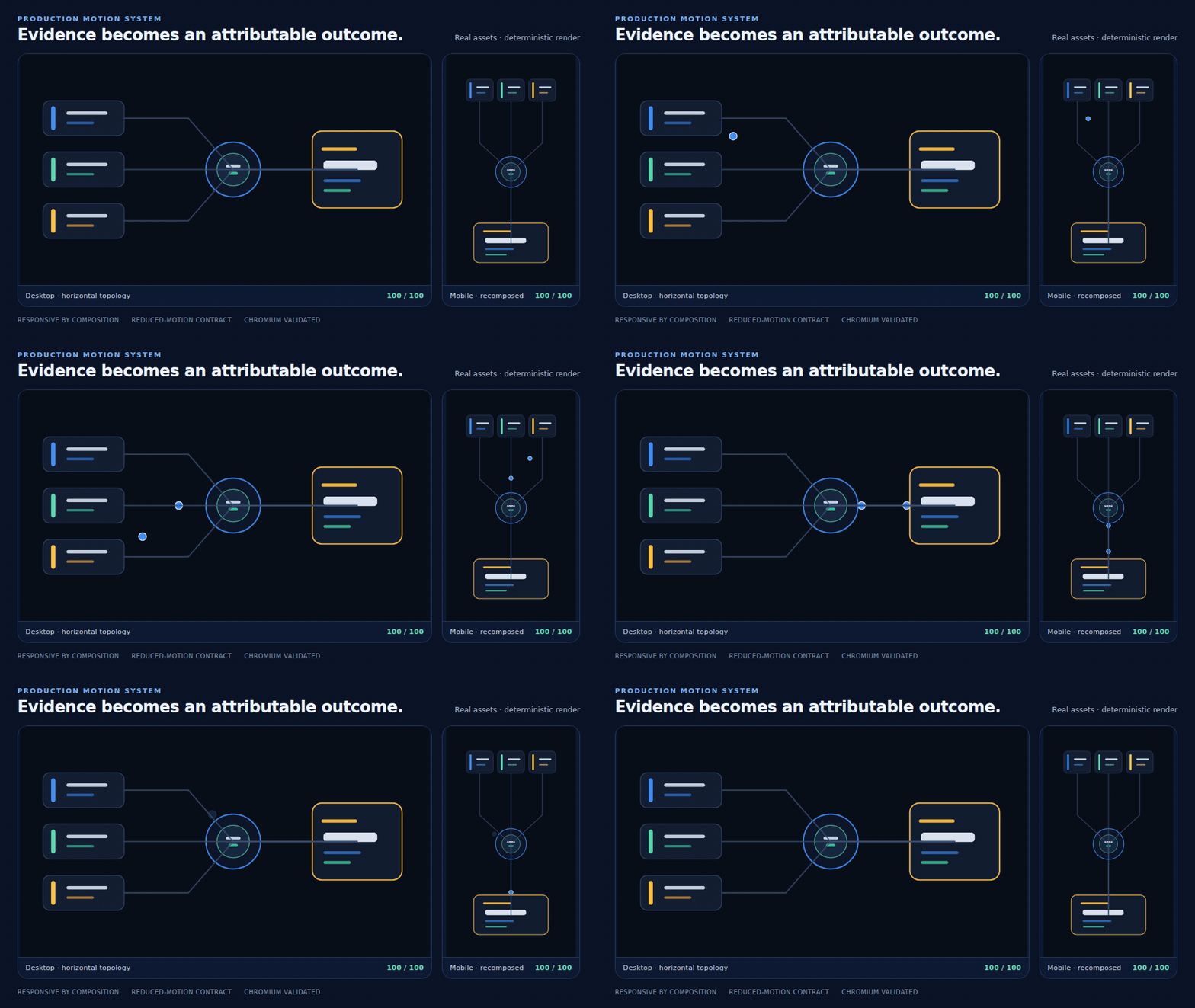
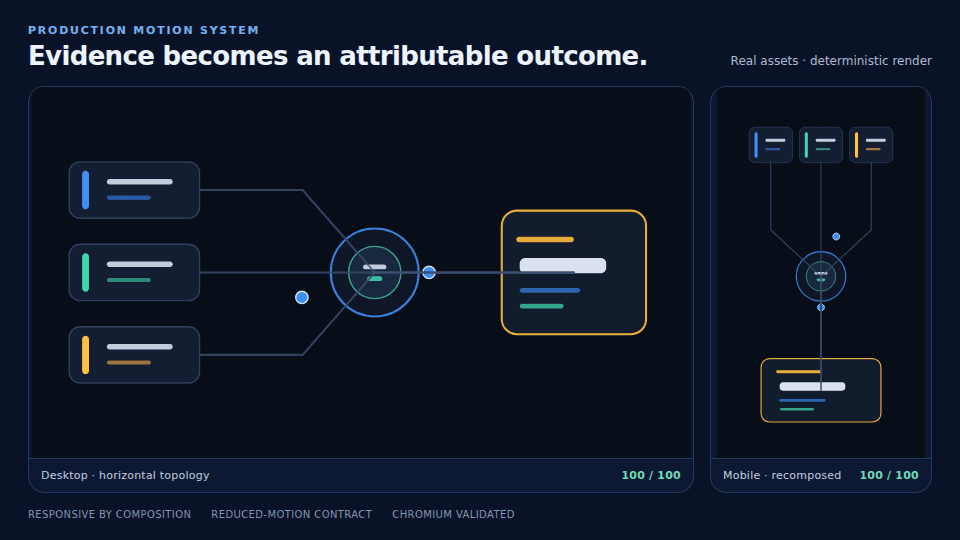
Try a built-in animation
This browser example selects from four checked-in recipes; it does not call an AI model. The sample downloads differ from the compiler's full five-artifact output.
Integrated deterministic studio
No model call · no API key · checked-in recipes
Recipe register
Signal Flow
Persistent rails route staggered signals into a credible processing outcome.
Install the public release
npm install https://github.com/HowdyDooToYou/lottie-animation-pipeline/releases/download/v2.0.0/motionproof-2.0.0.tgzAuthority trace
Authority / Verifier
Strict structure, vector-only content, quality, Chromium frames, meaningful motion, payload, and reduced-motion checks fail closed.
Receipt
Certification + raster evidence
What gets checked
MotionProof does not care which intelligence proposed the animation. It cares whether the artifact survives the same deterministic production contract.
Checks for strict structure, vector-only content, and payload constraints.
Verifies real Chromium frames, meaningful motion, and visual quality outside the provider.
Ensures the presence of a poster for fallback and promotes passing candidates into one atomic bundle.
Release proof
The documented July 26, 2026 release candidate passed the complete release gate: rebuilding deterministic assets, testing the contracts, rendering the production library, packing the npm distribution, installing it in a clean consumer, creating a real bundle, and completing an MCP handshake.
52
Automated tests across generation, certification, packaging, MCP, and runtime policy
27/27
Production Lotties strict-valid and visibly rendered in Chromium
5
Hashed artifacts promoted together in every certified bundle
Reproduce the release decision
npm ci
npm run check:release
Evidence summary
The role, enforced constraints, product judgment, and reproducible release evidence behind the public build.
Technical explanation
A proposal from an agent, model, or human enters a portable contract, gets proven against Chromium rendering, and is promoted into one atomic bundle.
Applications bring any provider through one small interface.
Humans and coding agents get stable stdout, exit codes, and structured failure.
Three tools expose creation, certification, and recipe discovery.
One portable workflow teaches compatible hosts the same definition of done.
The SDK, CLI, MCP server, Agent Skill, plugins, deterministic recipes, certifier, and local studio ship under the recipient's choice of MIT or Apache-2.0—including commercial use. Released open-core rights do not move backward.